Pilot's Service Model: How Outsourced Accounting Delivers the Work, and When It Breaks
Where Pilot’s accounting model works - and where it breaks.
Mark Bugas·September 2, 2026
The service model reality
Pilot is one of the most well-funded accounting firms in the market, with $150 million+ in venture capital raised. Their bet was to make bookkeeping repeatable enough to sell to as many companies as possible.
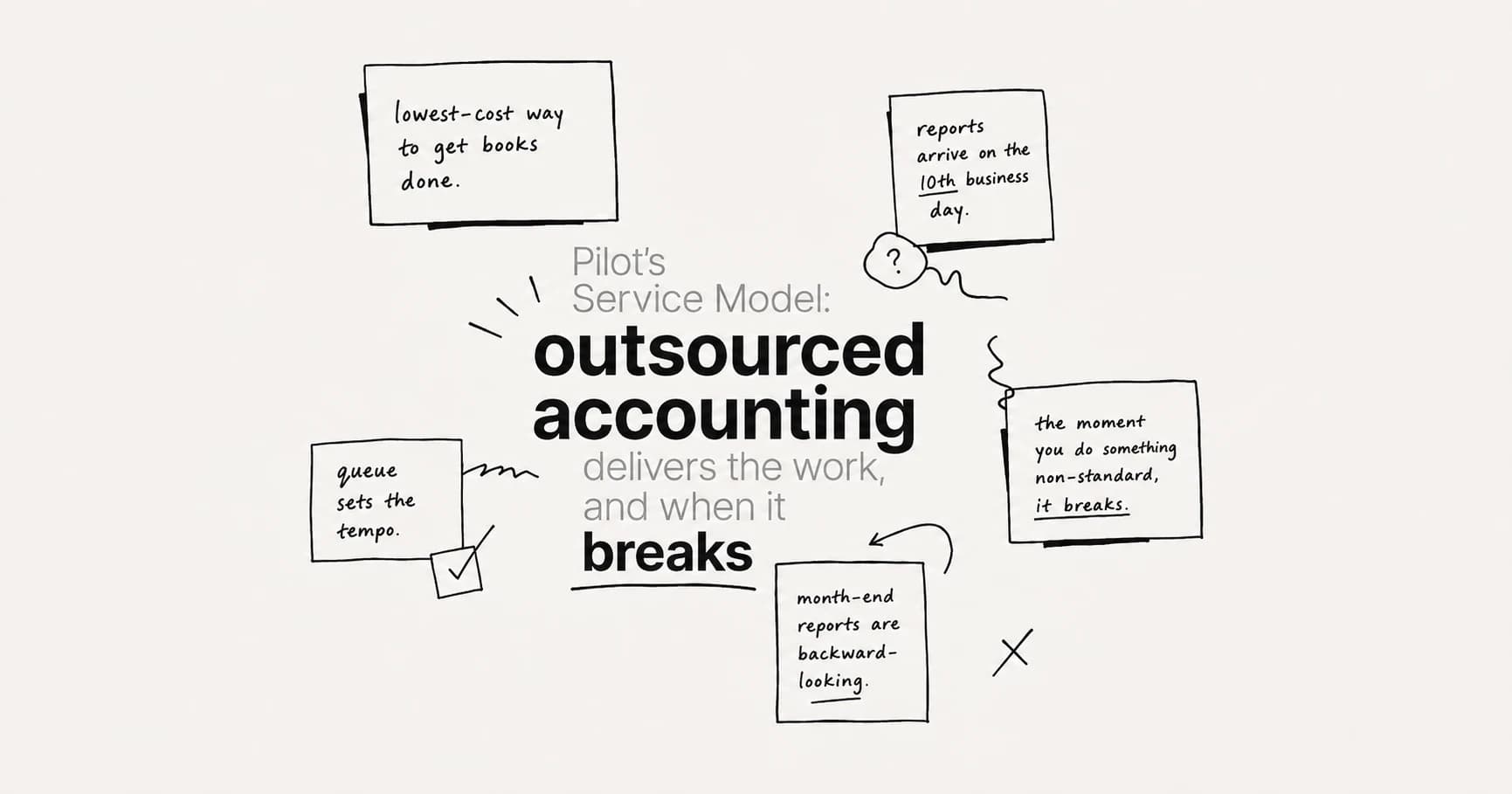
The pricing reflects that. Bookkeeping starts at $99 per month with an AI tier that, they claim, closes the books without a human touching them. Tax, operations support, and stock administration are add-ons. CFO advisory runs $1,750 to $5,250+ per month, which in practice means a monthly report and an optional call. On Pilot's Core plan, reports arrive on the 10th business day of the month. Pay for Custom and they arrive on the 6th. The pricing page tells you what you can buy. It doesn't tell you who does the work - and that's the part that matters.
Who Pilot serves
Pilot took bookkeeping and made it repeatable and cheap. If you want the lowest-cost way to get books done and a year-end package for your tax preparer, that's the job, and thousands of companies buy it for exactly that.
When it breaks
Outsourced accounting firms scale the old way: standardize the work, add people, and route each account to the cheapest capable person. Across much of the industry, that means offshore account managers. Even with the CFO add-on, the daily work goes to the most junior person the firm can staff - and the CFO is reactive. A report arrives monthly, with an optional call to discuss it. Anything beyond it happens only if you ask. Nobody is looking ahead, helping you strategize, or making judgment calls.
The person in your books has never taken the time to understand and map your back office workflows, and isn't going to pick up the phone and call you. They learn your business from your bank feed and run the same checklist they run on forty other accounts.
That works up to a point. It breaks when your business does something non-standard, or just gets more complex over time. Revenue recognition is the classic case: the moment you have usage-based pricing, annual prepays, or deferred revenue, a template books it wrong, and the mistakes start to pile up. Or maybe you’re a services business with very high AP/AR volume - that’s too different from SaaS for the same systems to work.
Response times reflect this service model too - there’s a queue, and the queue sets the tempo of your business.
The gap in the market
The outsourced model scales by adding people to manage clients. The quality of those hires, consistency, oversight, and proactiveness all suffer over time.
The alternative is to scale the systems and keep the people embedded - the Quill model. Every client gets a pod, not a queue. A forward-deployed engineer maps your back office workflows, then builds the systems, connectors, and automations around them. A dedicated compliance and HR manager and a dedicated financial analyst interact with your team weekly on a dedicated slack chanel and calls. Above the pod, a head of finance and a head of client success oversee every account as well as the systems supporting them.
AI does the grunt work - categorization, reconciliation, data pulls - and a company brain compounds what the system knows about your business. That leverage frees our operators to spend their hours on judgment, and nothing touches your systems without an expert reviewing it. It's how the pod stays senior without pricing like a CFO.
And the pod is in the business, not adjacent to it. A dedicated Slack channel, recurring calls, weekly cash, AR & AP reports, a model that updates immediately following month close, flags raised before you ask, opportunities surfaced. It’s a different way of working, and a harder system to build, but one that maintains quality with scale.
What to consider
If you want the cheapest way to get bookkeeping done, Pilot is built for exactly that job. If you’re looking for financial expertise to guide your decision-making, you should look elsewhere. As your company grows in complexity, look past the pricing page and ask about the delivery model: who touches your account each month, how they learn your business, and whether anyone tells you what's coming instead of reporting what already happened.
Quill is the autonomous back office for venture-backed startups - finance, HR, compliance, and fundraising, run by one embedded pod. See how it works.